Monday, June 8, 2009

NCSU launches on a severe supercell day

The NSSL2 team fills the balloon:


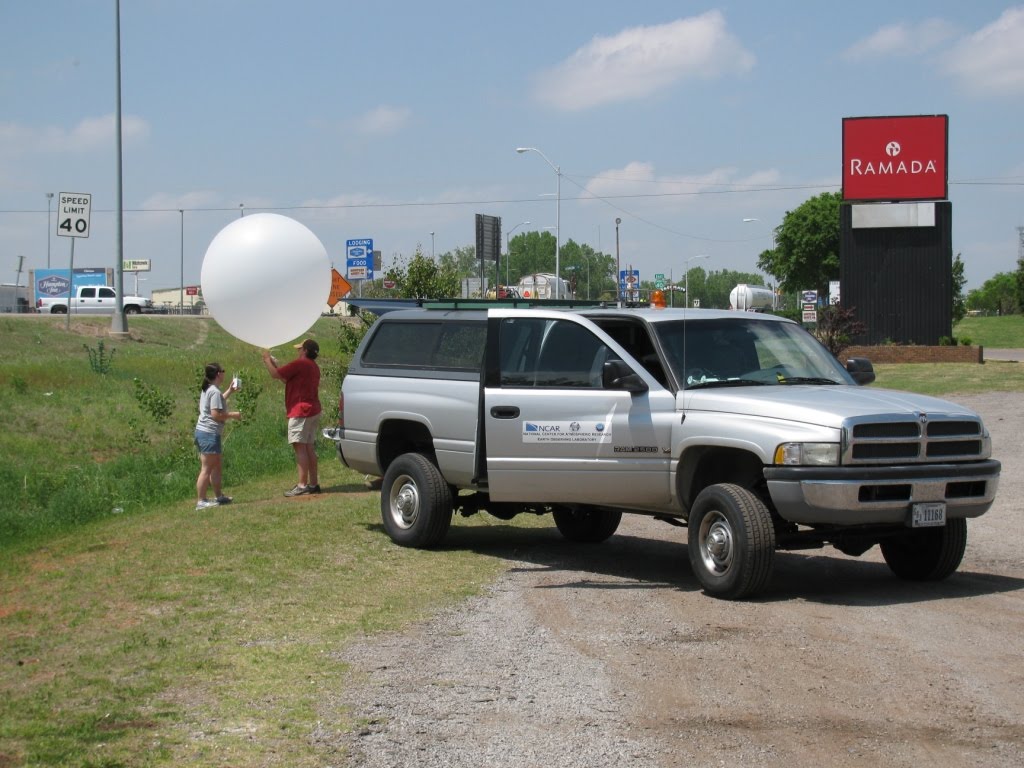
Matt Morin and Kate Rojowsky, ready for launch:


One of the many large hailstones found on the ground in the wake of the target storm (probably had been melting for 20 minutes or more!):


posted by Matt Parker

VORTEX2 Intercepts Its First Tornado (Posted By David Stark)

On Friday June 5, 2009, The VORTEX2 team intercepted a tornadic supercell near La Grange, Wyoming. The MGUAS teams launched balloons around the storm to observe its inflow environment, forward flank baroclinicity, and rear flank environment. Thankfully, the tornado did not harm anything other than a few trees and several fences. That does make trying to figure out how strong the tornado was more difficult. The National Weather Service did a damage SURVEY and rated it an EF-1 pending data from V2. The Doppler on Wheels data needs to be analzyed further, but it is possible the wind speeds were stronger than what the NWS saw from the little damage the tornado caused. Below are two photos that I took during the intercept. My sounding truck was located approximately 10-15 miles from the tornado.


NSSL2 Hits Dime to Nickel-Sized Hail (Posted By David Stark)

On Thursday, June 4, NSSL2, the sounding truck that I deploy in, ran into lots of hail along Interstate 80 along the Nebraska, Wyoming border. We pulled over to the side of the road until the hail let up and we were able to witness a fascinating rainbow right in front of us. Take a look!


Tuesday, June 2, 2009

Recent Student TV Interview (posted by Casey Letkewicz)

One of the consequences in taking part in a huge project like VORTEX2 is the constant media presence, not only by large stations like the Weather Channel but also the smaller, local stations. Yesterday in Hebron, Nebraska I (Casey Letkewicz) was stopped by a reporter from Lincoln who wanted an interview since V2 was in Nebraska yesterday and for a few days before. It was a pretty basic interview. They wanted to know why we were in Nebraska, what the goals of V2 are, and they also wanted to know a little bit about our mobile soundings team. Here's the link to the story on their website, including video: http://www.kolnkgin.com/home/headlines/46677602.html

One of the guys I was with was also snapped a picture of the interview (props goes to Mike Daniels from EOL for the image):

Tuesday, May 19, 2009

Weak, Short Lived Convection Intercept (Posted By David Stark)

Since the weather pattern is not conducive to producing supercells and tornadoes, we targeted some much weaker convection in southwestern Nebraska and northeastern Colorado today. More ordinary convection is not the target of VORTEX2, but any scientific data on thunderstorms will go a long way into better understanding the dynamics in and around them. Several of the sounding teams launched balloons early in the afternoon to get a good look at the temperature, moisture, and wind profiles of the troposphere. Below are some photos of our balloon preparations near our target storm.

Ground station to measure 2 meter temperature, humidity and pressure to make sure the radiosonde is close to registering similar data. The radiosonde is placed in the smaller white instrument just off the ground called an aspirator while this test is occuring.

Adam French (NCSU) and Chris Golubeski (NCAR) tie the radiosonde to their balloon.


Casey Letkewicz (NCSU) and Jen Standrige (NCAR) fill their balloon in preparation for a launch under the anvil of the target storm.

Saturday, May 16, 2009

Squall Line Deployment (posted by Casey Letkewicz)

Yesterday the balloon team was able to collect some amazing data on a squall line. While squall lines are outside of VORTEX2's direct mission, the data nevertheless will go a long way in helping scientists to better understand thunderstorms. Here's a few pictures of the team launching balloons before and after the line of storms passed through:

Prepping for a launch as the squall line approaches:


Adam French (left) steadying a balloon as it is being filled with helium:


From left to right: George Bryan (NCAR), Matt Morin, Kate Rojowsky, and Tim Lim (NCAR) getting ready to launch:


From left to right: Dr. Parker, George Bryan, Matt Morin, Tim Lim:


It looks like the next several days will not be favorable for chasing, so we are hoping to begin looking at and analyzing all of the data that the team has collected this past week!


Using the balloon bag, with Kate, Dave and Matt M. (Posted by Adam French)

One of the tools that we can employ to effectively launch balloons in windy conditions is a balloon bag. This is essentially a large, heavy duty tarp that has Velcro on the ends so that it can be wrapped into a long tube. You can then place the balloon inside the tube and inflate it. This not only protects the balloon, but also makes it much easier to handle as you maneuver it into position for a launch. In the photos below Kate, Dave and Matt M. (the NSSL2 team) demonstrate how this is done during operations on Friday, 5/15. We were conducting operations ahead of an approaching squall line, and conditions where quite windy, so the bag came in handy.

1) Inspect the bag for any debris such as small stones, twigs or anything else that may burst the balloon. Once inflated the balloons get quite large and can be easily popped.


2) Insert the balloon WELL into the bag. Otherwise it begins to squish out the end and becomes unwieldy, not to mention oddly shaped!


3) Inflate the balloon inside the bag. Safety goggles are a stylish accessory that will protect your eyes from flying latex in the event of a balloon burst.


4) Once the balloon is inflated, attach the radiosonde package that will record the temperature, humidity, wind and pressure data as the balloon ascends through the atmosphere.


5) With the sonde attached and the balloon still in the bag, move to your launch position. The balloon is easier to maneuver when it's inside the bag during windy conditions.


6) Once you're ready to launch have one or two people hold the bag (one of which should also be holding the sonde) while another person grabs the Velcro strip at the top of the bag and quickly rips it off. This allows the bag to open, releasing the balloon.


7) The balloon will rise out of the bag and it's up, up and away!